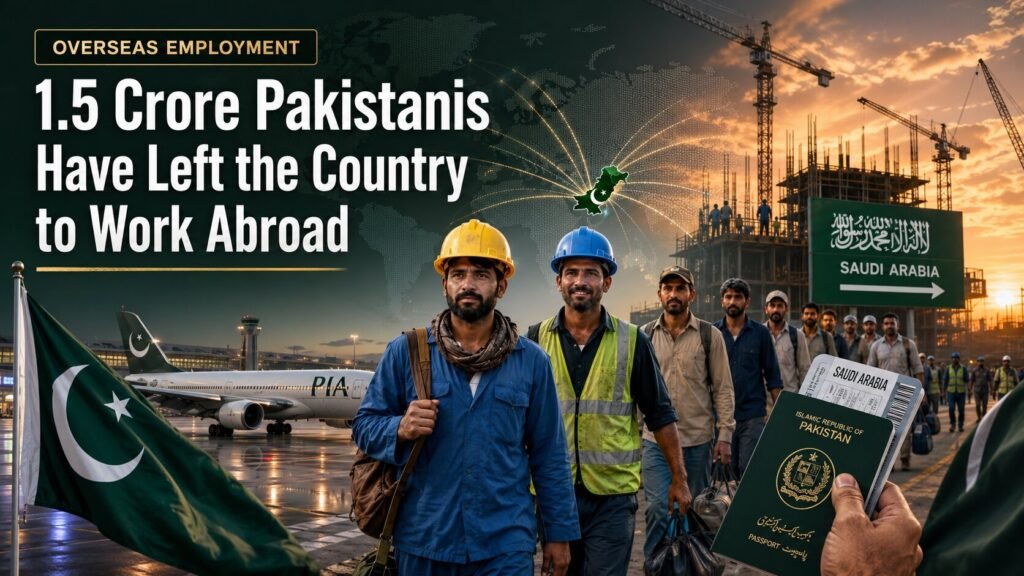
Pakistan’s Bureau of Emigration. Overseas Employment (BEOE) has released information showing that over 1.5 crore (15.13 million) Pakistanis have registered for overseas employment between 1971 and mid-2026.
In 2025 alone, 762,499 workers went abroad, marking a slight raise from 727,381 in 2024.
Saudi Arabia remains the top destination, hiring 530,256 Pakistanis in 2025 — nearly 70% of all overseas workers.
The figures shows shifting movements in labor migration, with Gulf countries dominating but non-Gulf destinations also gaining traction.
For Pakistani role seekers and policymakers, understanding these patterns is key for planning abilities development, negotiating labor agreements, and exploring new markets.
Quick takeaways
- Over 15 million Pakistanis have registered for overseas function as 1971.
- In 2025, 762,499 workers went abroad, up from 727,381 in 2024.
- Saudi Arabia hired 530,256 Pakistanis in 2025 — 70% of the full.
- Top Gulf destinations include UAE, Qatar, Bahrain, Oman, and Kuwait.
- Unskilled workers built up the largest category (366,092) in 2024.
- Non-Gulf destinations like Malaysia, Iraq, and UK have cumulative totals over 50,000 each.
Saudi Arabia remains by far the largest destination for Pakistani workers, hiring 530,256 Pakistanis in 2025, practically 70 percent of all overseas employment from the country during the year.
Overseas Employment Trends (2015–2025)
The count of Pakistanis registering for overseas work has fluctuated substantially over the past decade.
After a peak of 946,571 in 2015, registrations dropped sharply to 382,439 in 2018, before recovering to 862,625 in 2023.
The COVID-19 pandemic caused a steep decline to 225,213 in 2020, but numbers rebounded firmly in 2022 and 2023.
The 2025 figure of 762,499 indicates a stable demand for Pakistani labor abroad.
Central aspects influencing these trends include oil prices, construction booms in Gulf countries, and bilateral labor agreements.
The data reflects both economic shove elements in Pakistan and tug considerations in destination countries.
- 2015: 946,571 — highest in the decade
- 2020: 225,213 — pandemic low
- 2023: 862,625 — post-pandemic recovery peak
- 2025: 762,499 — slight decline from 2023 but secure
Top Destination Countries for Pakistani Workers
Saudi Arabia dominates as the primary destination, with 530,256 workers in 2025 and a cumulative overall sum of 7.87 million because 1971.
The UAE follows with 52,664 workers in 2025 and 4.48 million cumulative.
Qatar, Bahrain, Oman, and Kuwait also function prominently.
Qatar saw 68,376 workers in 2025, while Bahrain had 37,726.
Oman’s 2025 figure was 9,375, but its cumulative total is over 1 million.
Non-Gulf destinations are growing in importance.
Malaysia, Iraq, Libya, the UK, Italy, Cyprus, and South Korea each have cumulative totals ranging from 20,000 to 150,000 workers.
- Saudi Arabia: 530,256 (2025), 7.87M cumulative
- UAE: 52,664 (2025), 4.48M cumulative
- Qatar: 68,376 (2025), 488,787 cumulative
- Bahrain: 37,726 (2025), 297,775 cumulative
- Oman: 9,375 (2025), 1.08M cumulative
- Kuwait: 6,590 (2025), 199,275 cumulative
Skill Categories of Pakistani Workers (2024)
In 2024, the BEOE categorized workers by ability level.
Unskilled workers formed the largest set at 366,092, followed by proficient workers at 255,706.
Semi-skilled workers numbered 56,562, whereas highly trained and extremely qualified categories had 29,434 and 19,587 respectively.
This distribution points out a reliance on low-skilled labor, which regularly faces lower earnings and fewer protections.
Efforts to boost vocational training and certification could support Pakistanis access higher-paying posts abroad.
The data shows the want for targeted expertise development programs matched with demand in destination countries, especially in construction, healthcare, and technology sectors.
- Unskilled: 366,092
- Skilled: 255,706
- Semi-skilled: 56,562
- Highly skilled: 29,434
- Highly qualified: 19,587
Non-Gulf Destinations: Emerging Opportunities
Though Gulf countries remain the leading marketplace, non-Gulf destinations have attracted considerable numbers of Pakistani workers over the decades.
Malaysia leads with 149,601 cumulative workers, followed by Iraq (100,348) and Libya (81,818).
European countries like the UK (55,109), Italy (32,873), and Cyprus (20,949) also feature.
South Korea, with 20,642 workers, is a well-known Asian destination known for its manufacturing and agriculture sectors.
These markets present diversification and potentially better operating conditions.
However, they commonly demand higher competence levels and language proficiency, making them accessible to a smaller pool of workers.
- Malaysia: 149,601 cumulative
- Iraq: 100,348 cumulative
- Libya: 81,818 cumulative
- United Kingdom: 55,109 cumulative
- Italy: 32,873 cumulative
- South Korea: 20,642 cumulative
Implications for Pakistani Workers and Policymakers
The constant outflow of workers reflects both the demand for Pakistani labor and the restricted domestic post opportunities.
Remittances from overseas workers are a central piece of Pakistan’s economy, supporting millions of families.
For position seekers, understanding which countries and sectors are hiring can guide training and submission efforts.
The dominance of Saudi Arabia means that workers should be mindful of the particular visa procedures, labor laws, and cultural norms there.
Policymakers can use this records to negotiate better labor agreements, improve pre-departure training, and explore new markets.
Diversifying destinations can cut dependency on any lone country and mitigate dangers from geopolitical or economic shocks.
- Remittances are a important economic contributor.
- Workers should research destination-specific conditions.
- Ability development can unseal higher-paying opportunities.
- Diversification of destinations cuts threat.
Yearly Overseas Employment Registrations (2015–2025)
| Year | Workers Registered |
|---|---|
| 2015 | 946,571 |
| 2016 | 839,353 |
| 2017 | 496,286 |
| 2018 | 382,439 |
| 2019 | 625,876 |
| 2020 | 225,213 |
| 2021 | 288,280 |
| 2022 | 832,339 |
| 2023 | 862,625 |
| 2024 | 727,381 |
| 2025 | 762,499 |
Frequently Asked Questions
How many Pakistanis have gone abroad for work since 1971?
According to the Bureau of Emigration and Overseas Employment, over 15.13 million Pakistanis have registered for overseas employment between 1971 and mid-2026.
This cumulative figure covers workers from all skill levels and destinations, making Pakistan one of the largest labor-exporting countries in the region.
Which country hires the most Pakistani workers?
Saudi Arabia is the largest employer of Pakistani workers, hiring 530,256 in 2025 alone — almost 70% of all overseas workers that year.
Cumulatively, over 7.87 million Pakistanis have worked in Saudi Arabia given that 1971, driven by demand in construction, solutions, and oil-related sectors.
What skill categories do Pakistani workers fall into?
In 2024, the largest cluster was unskilled workers (366,092), followed by proficient workers (255,706), semi-skilled (56,562), very skilled (29,434), and extremely qualified (19,587).
This distribution shows a weighty reliance on low-skilled labor, though trained and very proficient categories are growing.
Are there non-Gulf destinations for Pakistani workers?
Yes, several non-Gulf countries have attracted Pakistani workers.
Malaysia leads with 149,601 cumulative workers, followed by Iraq (100,348), Libya (81,818), the United Kingdom (55,109), Italy (32,873), Cyprus (20,949), and South Korea (20,642).
These markets give diversification but frequently require higher expertise.
How has the COVID-19 pandemic affected overseas employment?
The pandemic caused a keen decline in overseas registrations, dropping from 625,876 in 2019 to 225,213 in 2020.
But, numbers rebounded quickly, reaching 832,339 in 2022 and 862,625 in 2023.
The recovery reflects resumed global mobility and continued demand for labor in Gulf countries.
Final Thoughts
The BEOE information confirms that overseas employment remains a critical livelihood pathway for millions of Pakistanis.
With over 1.5 crore workers having migrated as 1971, the trend displays no signs of slowing, though destinations and expertise demands are changing.
For workers, staying informed about marketplace patterns, skill needs, and permitted protections is necessary.
For policymakers, the figures offers a foundation for planned planning to maximize the benefits of labor migration while safeguarding worker rights.