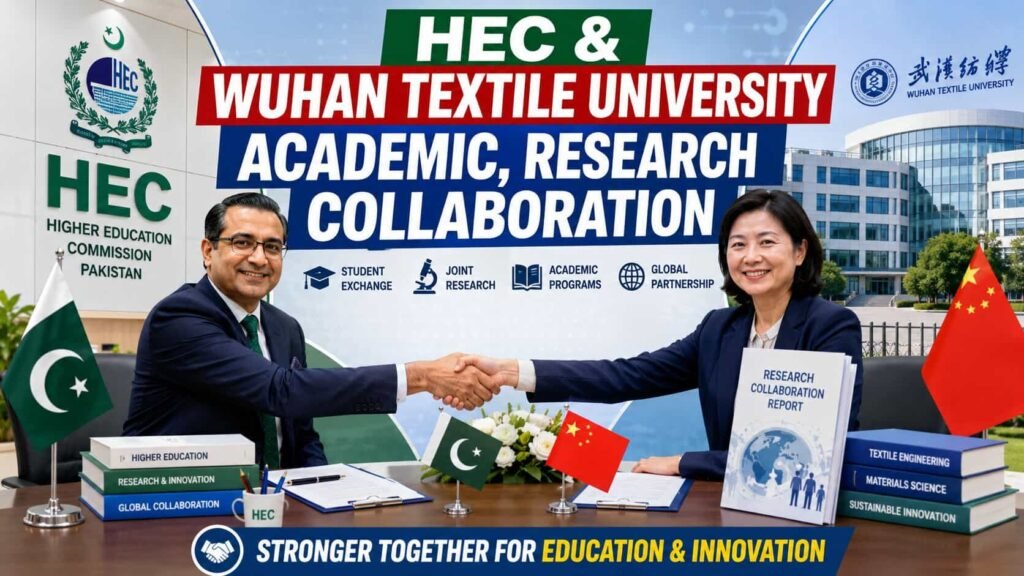
Pakistan’s Higher Education Commission. Wuhan Textile University have discussed a broader academic partnership covering joint research, student and faculty exchanges, postgraduate supervision, Chinese language education and technical training for university staff.
The Higher Education Commission (HEC) of Pakistan hosted a experienced delegation from Wuhan Textile University (WTU), China, in Islamabad on July 7, 2026, as both sides explored new prospects for cooperation in higher education, scientific research and innovation.
The meeting was chaired by HEC Executive Director Dr. Zia Ul Haq. Senior HEC officials joined representatives from the National University of Technology (NUTECH), Pakistan Science Foundation, Ministry of Science and Technology and other applicable institutions.
Even though no new Memorandum of Understanding was announced during the meeting, HEC. WTU agreed on several priority spheres that could lead to proper university-level partnerships in the future.
Key Areas Discussed During the Meeting
The proposed domains of cooperation contain:
- Joint academic and scientific research projects
- Faculty and student exchange programmes
- Joint supervision of postgraduate researchers
- Sandwich degree and research programmes
- Undergraduate academic collaboration
- Chinese language programmes in Pakistani universities
- Curriculum development for rising technical disciplines
- Short-term certification and technical training for university technicians
These initiatives remain at the planning and institutional coordination stage. Individual universities would require to form official arrangements before launching precise degree, exchange or research programmes.
HEC Reaffirms Support for International Partnerships
Welcoming the Chinese delegation, Dr. Zia Ul Haq reaffirmed HEC’s commitment to developing targeted international partnerships capable of improving academic standards, research capacity and institutional performance in Pakistan.
He pointed out the importance of sustained engagement between Pakistani. Chinese universities, especially in fields where academic expertise can be connected with industrial development, technological innovation and national research priorities.
The meeting also focused on creating partnerships that relocate beyond ceremonial agreements. The proposed initiatives are intended to offer hands-on openings for researchers, faculty participants, postgraduate students, technical personnel and participating universities.
Wuhan Textile University Highlights Its Academic Expertise
The visiting delegation represented Wuhan Textile University’s School of Biomedical Engineering and presented an overview of the university’s teaching and research portfolio.
WTU shown its expertise in areas such as:
- Textile and fibre technology
- Sensor technology
- Genetic engineering
- Biomedical and interdisciplinary research
- Technical and applied education
The delegation also briefed participants about WTU’s present academic engagement with NUTECH and the Institute of Space Technology.
Building on these relationships, the Chinese university expressed interest in forming connections with additional higher education institutions throughout Pakistan.
Such partnerships could enable Pakistani universities to participate in joint research, academic mobility. Specialised training in fields where WTU has established teaching or laboratory capacity.
Joint Research and Postgraduate Opportunities Explored
A primary piece of the discussion focused on expanding cooperation at the postgraduate and research levels.
HEC and WTU considered joint supervision arrangements under which researchers could obtain academic guidance from faculty participants in both Pakistan and China. They also discussed sandwich programmes that would permit students to complete section of their research or academic training at a partner institution.
When formally developed, such arrangements could hand over postgraduate students access to specialised laboratories, research methods. Academic expertise that may not be open at their home university.
Faculty exchange programmes were also identified as a feasible route for building long-term research relationships. Visiting faculty members could participate in collaborative projects, lectures, laboratory operate and curriculum development.
No submission schedule, eligibility criteria or funded scholarship programme was announced at the meeting.
Chinese Language Skills Identified as an Important Requirement
The Chinese delegation emphasised that language proficiency remains essential for Pakistani students interested in pursuing undergraduate education in China.
Participants thus discussed boosting Chinese language education in Pakistani universities. The proposed method could assist students gather university admission or communication needs though preparing them for academic and skilled life in China.
HEC and WTU agreed to explore doable cooperation with the National University of Up-to-date Languages (NUML) in this sphere.
The proposal could eventually involve language courses, preparatory programmes or institutional assist for students planning to study in China. But, the meeting didn’t confirm particular universities, course dates or admission procedures.
Undergraduate Collaboration Could Lead to Future MoUs
HEC agreed to spot Pakistani universities interested in setting up undergraduate-level academic cooperation with Wuhan Textile University.
Once right institutions have been identified, the universities would be able to grip straight discussions and develop formal partnerships through Memoranda of Understanding.
Feasible models could involve academic exchanges, collaborative teaching, curriculum coordination or other jointly approved arrangements. The precise setup would depend on the agreements reached by the participating institutions.
This approach gives universities the prospect to assess their academic priorities and technical capacity before entering a proper partnership.
Support Under the Belt and Road Initiative
The WTU delegation also expressed its willingness to aid HEC-linked academic activities under the Belt and Road Initiative.
Potential spheres of back discussed during the meeting included collaborative conferences, development of undergraduate. Postgraduate curricula and academic initiatives designed to advance textile and fibre technology in Pakistan.
Textile education was a major portion of the discussion because of WTU’s specialised background in the field. Greater university-level teaching and research in textile and fibre technology could assist interdisciplinary function involving engineering, materials science, manufacturing, sensors and industrial innovation.
Any new academic programme would still demand development and approval through the related Pakistani university and regulatory procedures.
Technical Training for University Staff
Another useful proposal involved short-term certification and technical training for university technicians.
HEC and WTU agreed to examine programmes that could strengthen the competencies of personnel responsible for working laboratories, keeping up technical equipment. Supporting research activities.
Technical workforce are essential to the secure and productive operation of university laboratories. Specialised training could aid institutions boost equipment management, laboratory procedures and aid for faculty and student researchers.
The format, duration, participating institutions and certification conditions for these programmes haven’t yet been announced.
What Happens Next?
The meeting produced a structure for further discussions rather than an prompt launch of new academic programmes.
The expected next moves include:
- HEC spotting Pakistani universities interested in undergraduate collaboration with WTU.
- Participating institutions beginning frank discussions on fitting academic arrangements.
- Universities developing and signing MoUs where mutually agreed.
- HEC and applicable institutions examining faculty exchange opportunities.
- Stakeholders exploring Chinese language cooperation, potentially involving NUML.
- Both sides considering short-term technical certification and training programmes.
Students and faculty participants should hence pause for official announcements from HEC or participating universities before treating any proposed exchange, degree or training programme as unseal for submissions.
Why This Collaboration Matters
The discussions reflect an effort to expand Pakistan-China higher education cooperation into specialised and hands-on academic domains.
For Pakistani universities, the proposed partnership could create access to international faculty, research facilities, postgraduate supervision and technical expertise. Wuhan Textile University could also expand its institutional network in Pakistan and create research connections suited to regional academic and industrial requires.
The long-term worth of the initiative will depend on how swiftly the proposed areas are converted into funded programmes, signed agreements. Accessible opportunities for students and researchers.
The meeting concluded with both sides renewing their commitment to sustained institutional engagement and stronger academic and research cooperation between Pakistan and China.
Frequently Asked Questions
Did HEC and Wuhan Textile University sign an MoU?
No new MoU was announced during the meeting. HEC will first pinpoint interested Pakistani universities, which may later set up proper partnerships with WTU through separate MoUs.
What opportunities were discussed for Pakistani students?
The discussions covered student mobility, undergraduate collaboration, sandwich programmes, joint postgraduate supervision and doable Chinese language preparation. No application routine has been announced.
Which research fields were highlighted?
WTU pointed out expertise in textile and fibre technology, sensor technology, genetic engineering, biomedical engineering and related interdisciplinary fields.
Will Chinese language courses be introduced in Pakistan?
HEC and WTU agreed to explore mechanisms for boosting Chinese language programmes in Pakistani universities, potentially in collaboration with NUML. Precise courses and dates haven’t yet been confirmed.
Were any scholarships announced?
No scholarship, funding sum or submission cutoff was announced as part of the meeting.
Where should students check for future opportunities?
Future programmes should be confirmed through formal announcements issued by HEC, Wuhan Textile University or the participating Pakistani universities.