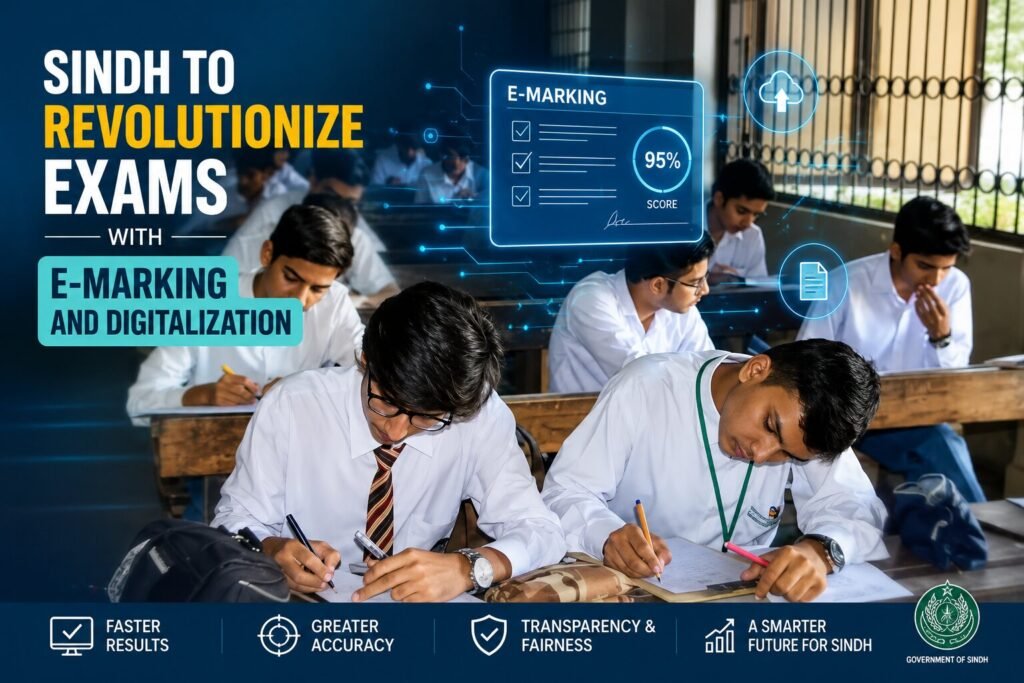
The Sindh government has announced a key overhaul of the provincial examination system, moving from traditional manual marking to a completely digital e-marking process.
The decision was finalized during a high-level meeting between Minister for Universities. Boards Muhammad Ismail Rahoo and representatives from the Asian Development Bank (ADB).
This initiative aims to carry transparency, efficiency, and speed to the examination workflow throughout all educational boards in Sindh.
The task covers training for board workforce and procurement of cutting equipment to assist the digital transition.
For students, teachers, and administrators, this reform promises faster findings, reduced errors, and a more consistent assessment system.
The move fits with global best practices in educational technology.
Quick takeaways
- Sindh public sector will put in place e-marking over all educational boards to substitute manual marking.
- The venture is supported by the Asian Development Bank (ADB) and involves high-level planning.
- IT pros will train board team to tackle the new digital system effectively.
- Refined equipment will be procured to guarantee smooth transition and operation.
- The reform aims to raise transparency, reduce errors, and speed up effect announcements.
- This is piece of a broader digitalization push in Sindh's education sector.
The shift to e-marking will eliminate manual errors and delays, securing students obtain exact and timely outcomes.
Background: Why Sindh Needs Exam Reform
For years, Sindh's examination boards have relied on manual marking, which is time-consuming and prone to human error.
Delays in consequence announcements and allegations of marking inconsistencies have been frequent.
The COVID-19 pandemic shown the require for digital remedies in education, pushing the state to explore technology-driven alternatives.
The partnership with ADB brings both funding and technical expertise to this reform.
Key Features of the E-Marking System
The new e-marking system will digitize answer sheets, allowing examiners to assess them on screen with standardized rubrics.
This reduces subjectivity and speeds up the routine.
Key features include
Digital scanning of answer scripts • Online marking interface with built-in grade reviews • Automated aggregation of marks • Protected storage of digital records • Real-time monitoring of marking progress
Role of the Asian Development Bank
The ADB is providing financial and technical aid for the digitalization task.
During the meeting, ADB representatives discussed the rollout roadmap and reference conditions.
The bank has know-how in comparable education technology projects throughout Asia, and its involvement guarantees adherence to international standards.
The partnership also involves capacity building for board workforce.
Training and Capacity Building for Staff
IT specialists will carry out specialized training programs for board employees to familiarize them with the e-marking software and hardware.
The training covers
Handling digital reply scripts • Using the marking interface • Data security protocols • Troubleshooting common issues • Keeping up equipment
Procurement of Advanced Equipment
The public sector will procure high-speed scanners, safe servers, and backup systems to back the digital workflow.
The equipment will be distributed over all boards in Sindh.
A centralized information center may also be established to confirm uniform standards and records integrity.
The procurement procedure will track transparent bidding procedures.
Expected Benefits for Students and Institutions
Students will get effects faster, with fewer errors.
The digital system also lets for simple rechecking and verification of marks.
Institutions will upside from easy administrative procedures and reduced workload.
The figures collected can be employed for analytics to refine teaching and assessment approaches.
Challenges and Implementation Timeline
Challenges cover ensuring reliable internet connectivity throughout boards, managing resistance to alter, and maintaining information security.
The state schemes a phased rollout, beginning with a pilot in selected boards.
The packed execution is expected to grab 12-18 months, with the first e-marked exams likely in the next academic session.
Comparison with Other Provinces
Punjab has by now introduced digital marking for hands-on exams, and Khyber Pakhtunkhwa is piloting e-marking in some districts.
Sindh's thorough approach, with ADB support, could place a benchmark for the country.
A unified digital system over provinces could eventually enable inter-board outcome verification and decrease fraud.
E-Marking Implementation Plan Overview
| Component | Details | Timeline |
|---|---|---|
| Training | IT experts train board staff on e-marking software and hardware | First 3 months |
| Equipment | High-speed scanners, servers, backup systems procured | Months 3-6 |
| Pilot | E-marking tested in selected boards | Months 6-9 |
| Full Rollout | All boards adopt e-marking system | Months 9-18 |
| Monitoring | Real-time oversight and quality assurance | Ongoing |
Frequently Asked Questions
What is e-marking and how does it differ from manual marking?
E-marking is a digital workflow where examiners assess scanned response sheets on a computer screen using standardized rubrics.
Unlike manual marking, it reduces human error, speeds up effect compilation, and allows for real-time monitoring.
The system also confirms consistent submission of marking criteria throughout all examiners.
When will the e-marking system be implemented in Sindh?
The rollout will be phased over 12-18 months.
A pilot project in selected boards is expected in the first 9 months, followed by complete rollout over all educational boards in Sindh.
The exact begin date depends on procurement and training completion.
How will the e-marking system benefit students?
Students will obtain correct findings faster, with reduced chances of marking errors.
The digital system also creates it easier to put in for rechecking and obtain verified note sheets.
Also, the transparency of the routine creates trust in the examination system.
What role does the Asian Development Bank play in this project?
The ADB supplies financial assist and technical expertise for the digitalization of Sindh's examination system.
Their involvement guarantees the venture follows international best practices and contains capacity building for area team.
The bank has background in similar education technology projects in other countries.
Will the e-marking system be used for all subjects and grades?
Initially, the system will be introduced for major subjects with high enrollment.
Over time, it will be expanded to include all subjects and grades.
The government blueprints to eventually digitize the complete examination process from registration to consequence declaration.
Final Thoughts
The Sindh public sector's decision to carry out e-marking throughout all educational boards marks a major step toward modernizing the province's examination system.
With aid from the Asian Development Bank, the task promises greater transparency, efficiency, and accuracy in outcome processing.
Students and educators can appearance forward to faster outcomes and a more dependable assessment process.
As challenges remain, the phased method and concentrate on training and equipment procurement give a sturdy foundation for success.
This reform positions Sindh as a leader in educational technology in Pakistan.